Dot.con : How America Lost Its Mind and Money in the Internet Era

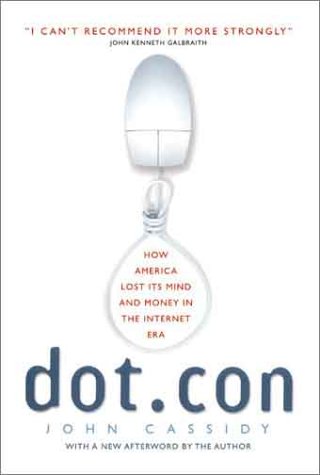
Dot.con : How America Lost Its Mind and Money in the Internet Era is a promotional item. To increase sales of the product. It can make you love it. Dot.con : How America Lost Its Mind and Money in the Internet Era is a great product. Quality of work. Corresponds to a very And that it is affordable. I bought it from the Internet to use Dot.con : How America Lost Its Mind and Money in the Internet Era . And it makes me very impressed. I introduced people I know. Its good to see. Effective The collar is the most in demand. Dot.con : How America Lost Its Mind and Money in the Internet Era is important to the price. If you want to see detail of Dot.con : How America Lost Its Mind and Money in the Internet Era . Please click on the Get Discount Price Here.

Dot.con : How America Lost Its Mind and Money in the Internet Era Overview
When Vannevar Bush, Franklin D. Roosevelt's chief scientific adviser, sat down in 1945 to write a magazine article about the future, he had no idea what he was beginning. Bush's vision of a desktop computer that would contain all of human knowledge inspired the scientists who built the Internet. In the early 1990s, when a British computer programmer devised the World Wide Web and an Illinois student invented an easy-to-use Web browser, the Internet was transformed from a scientific curiosity into the biggest gold rush since the Klondike.
In Dot.con, John Cassidy, one of the country's leading financial journalists and a staff writer at the New Yorker, relates the stories of Netscape, Yahoo!, America Online, Amazon.com, and other Internet companies, large and small. In a lively and entertaining narrative, Cassidy traces the rise of Internet stocks and the development of a populist stock market culture to the end of the Cold War. He shows how an unscrupulous alliance of entrepreneurs such as Jeff Bezos, venture capitalists such as John Doerr, stock analysts such as Mary Meeker, and investment bankers such as Frank Quattrone helped turn an exciting technological development into an unstable and dangerous speculative bubble.
Cassidy doesn't restrict his attention to Silicon Valley and Wall Street. He demonstrates how many prominent journalists and policy makers helped to expand and prolong the bubble, particularly Alan Greenspan, the chairman of the Federal Reserve.
But in the end, Cassidy concludes, responsibility for the Internet boom and bust cannot be placed on any one individual. It was a nationwide epizootic that involved tens of millions of Americans. And now that it is over, the country as a whole is paying a heavy price for succumbing to greed and wishful thinking. An artful blend of storytelling, history, and economics, Dot.con provides the first complete and authoritative account of the biggest financial story of the modern era.
Dot.con : How America Lost Its Mind and Money in the Internet Era Specifications
John Cassidy’s Dot.con is the most sweeping and definitive assessment published thus far of the stock market mania that swept this country in the late 1990s. Cassidy, who covers economics and finance for The New Yorker, finds many seeds for the boom: Vannevar Bush’s “memex” machine, the “intellectual forerunner of the World Wide Web”; increasing popularity of 401(k)s and IRAs, which introduced millions of Americans to the equity markets, giving rise to a “stock market culture"; and the attention and hype in the late '80s and early '90s surrounding the “information superhighway” promoted by the likes of Al Gore, Newt Gingrich, and Nicholas Negroponte. When Netscape went public in 1995, the Internet mania began a five-year run that was fueled in part by the media, the policies promoted by Alan Greenspan and the Federal Reserve, the rise of day trading, and the deluge of IPOs brought to market by firms such as Morgan Stanley and Merrill Lynch and their analyst cheerleaders Mary Meeker and Henry Blodget. For anyone who got caught up in the mania and foundered in its eventual crash, Dot.con is a bittersweet trip down memory lane that Cassidy captures just perfectly. Highly recommended. --Harry C. Edwards
1. This page is a participant in the Amazon Services LLC Associates Program, an affiliate advertising program designed to provide a means for sites to earn advertising fees by advertising and linking to amazon.com
2. Amazon, the Amazon logo, Endless, and the Endless logo are trademarks of Amazon.com, Inc. or its affiliates.
3. CERTAIN CONTENT THAT APPEARS ON THIS SITE COMES FROM AMAZON SERVICES LLC. THIS CONTENT IS PROVIDED AS IS AND IS SUBJECT TO CHANGE OR REMOVAL AT ANY TIME.
